


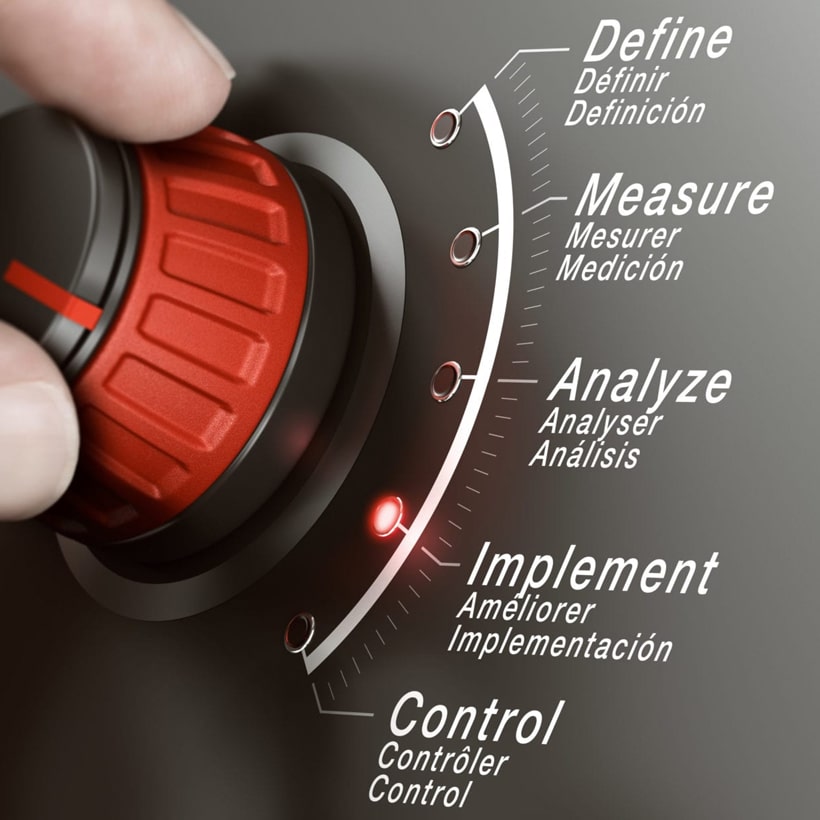
Six Sigma is a methodology for driving breakthrough performance in process development. This program is structured around the DMAIC model. DMAIC is about “improving” quality, cost, productivity and meet-market requirement.
This program is aimed to provide customization in developing charismatic individuals on remodelling of process in an organization to improve quality of process outputs by identifying and removing defects/errors/non-value-added activities.
- Section 1: Define
- Section 2: Measure
- Section 3: Analyze
- Section 4: Improve
- Section 5: Control
THE SIX SIGMA YELLOW BELT is aimed at those new to the world of Six Sigma who has a small role, interest, or need to develop foundational knowledge. Yellow belts can be entry level employees who seek to improve their world or executive champions who require an overview of Six Sigma and define measure, analyse, improve and control model (DMAIC).
Six Sigma is a business management strategy originally developed by Motorola, USA in 1986. As of 2011, it is widely used in many sectors of industry to achieve breakthroughs in Cost, Quality, Yield, Productivity, Delivery thus improve Profit Margin. Each Six Sigma project carried out within an organization follows a defined sequence of steps and has quantified financial targets. Six Sigma BLACK BELT deployment is a company process improvement and productivity gain.
Six Sigma is a business management strategy originally developed by Motorola, USA in 1986. As of 2011, it is widely used in many sectors of industry to achieve breakthroughs in Cost, Quality, Yield, Productivity, Delivery thus improve Profit Margin. Each Six Sigma project carried out within an organization follows a defined sequence of steps and has quantified financial targets. Six Sigma BLACK BELT deployment is a company process improvement and productivity gain.
The Lean Six Sigma methodology, developed in 1986, is a breakthroughs in productivity gains, PPM reduction, cycle improve and the profit margin. Many companies such as General Electric, Lear Corp that successfully implemented the Lean Six Sigma program were benefiting unprecedented growth, profitability, and recognition with the Malcolm Baldrige National Quality Award. Lean Six Sigma provides businesses with the tools to improve the sigma reduction and vast improvement in profits. Companies with an effective infrastructure that remains consistent with the classic Lean Six Sigma system realize dramatic income improvements after implementation.
Since a key role for Black Belts is to effectively lead project teams, our program prepares your candidates to do just that. The following Black Belt Program gives your candidates the skills and knowledge they need for the exceptional leadership of business improvement projects. Upon completing each segment of training, participants immediately apply concepts and tools taught in training to their real-time improvement projects.
A systematic process is one of the critical components of a corporation in which products and/or services are designed, created, and delivered to customers. For corporations to become more competitive, they must effectively manage their business processes to ensure that all key facets of their operations are optimally performed. Lean Six Sigma (LSS) is the discipline in which the process stakeholders utilize various optimize, automate, verify, and sustain business processes. The combination of methodologies used to manage a corporation’s business processes is with the aim of making the processes structured, repeatable, and predictable.
Design for Six Sigma (DFSS) is a methodology for driving breakthrough performance in new product development. This program is structured around the DMADV model – a five phase model like the more traditional DMAIC model. DMADV is about “designing in” quality, cost savings and faster time-to-market.


